Skip to content
Zac Martin

General election · Tuesday, November 3, 2026

Four amendments at the bottom of your ballot.
I am voting yes on all four.

Every South Dakota voter will see Constitutional Amendments I, J, K and L this November. The Legislature put all four there in 2025. None came from a petition. Here is what each one does, why I am voting yes, the other side's best argument, and how District 32's current lawmakers voted when Pierre sent them to you.

I

Amendment I

House Joint Resolution 5001 (2025)

Medicaid expansion stays only while Washington keeps its 90 percent promise.

Zac votes YES
On the ballot because
Rep. Will Mortenson and Sen. Casey Crabtree. House 59 to 7 (January 21, 2025). Senate 31 to 3 (March 3, 2025).
How District 32's lawmakers voted to put it on your ballot
  • Steve Duffy (R, House)Yes
  • Nicole Uhre-Balk (D, House)No
  • Helene Duhamel (R, Senate)Yes

Floor roll calls, Legislative Research Council. These are votes to refer the question to voters.

What it does

“An Amendment to the South Dakota Constitution that Repeals Expanded Medicaid Coverage if Federal Funding for the Program Drops below 90%.” Attorney General's ballot title

In 2022, voters wrote Medicaid expansion into the state constitution (Amendment D, 56 percent yes). It covers adults 18 to 64 earning up to about 138 percent of the federal poverty level. Federal law has the federal government paying 90 percent of the cost and South Dakota paying 10.

Amendment I adds one condition: if the federal share ever drops below 90 percent, the constitution no longer requires the state to keep the expanded coverage. Regular Medicaid for children, pregnant women, people with disabilities and the elderly is a separate program and is not touched.

Nothing changes on November 4. The federal share is still 90 percent today. This amendment only decides who holds the pen if that number moves.
Why I am voting yes

  1. It is a safeguard, not a repeal. As long as Washington keeps the deal South Dakotans voted for, every word of Amendment D stays in force. The Attorney General reads the amendment as ending the constitutional requirement if the federal share falls; the sponsors read it as handing the decision back to the Legislature and the voters. Under either reading, the trigger is Washington breaking its promise, not Pierre breaking ours.

  2. The math lands on everything else we pay for. For every 10 points of expansion cost shifted from Washington to South Dakota, the state would need about $36 million more every year, according to the sponsors' statement in the official pamphlet. That money comes from the same general fund that pays for schools, state troopers, nursing home care and services for people with disabilities, or it comes from a tax increase. Those are the only two doors.

  3. A constitution should not sign a blank check. South Dakota ran Medicaid for more than fifty years without putting it in the constitution. Amendment D locked one program's eligibility rules into our founding document at a price set in Washington. If the price changes, the people who pay the bill should get to decide whether it is still worth it. That is the whole of Amendment I.

  4. It protects the people regular Medicaid was built for. Children, pregnant mothers, the disabled and the elderly in nursing homes are covered by the original program, and Amendment I does not change a line of it. What it prevents is a forced cut to those programs to keep paying for an expansion Washington stopped funding.

  5. Pierre agreed across party lines. The House passed HJR 5001 by 59 to 7 and the Senate by 31 to 3. Lt. Gov. Tony Venhuizen, Senate Majority Leader Casey Crabtree and Rep. Will Mortenson wrote the argument for it.

The other side, fairly

About 30,000 South Dakotans have coverage through expansion. Opponents, including Deb Fischer-Clemens, RN, say a yes vote could end that coverage automatically if the federal share slips, and that a no vote keeps the 2022 decision intact.

My answer

That concern is real and it belongs in the open. Some of those 30,000 are our neighbors in North Rapid, and some are people in their early sixties who are not yet on Medicare. If the day ever comes that Washington cuts its share, I will be in Pierre fighting for a transition that does not simply drop working people. What I will not do is pretend the bill never comes due. A constitution that forces the state to pay any price Washington names is not a promise to the vulnerable. It is a promise to Washington.

J

Amendment J

Senate Joint Resolution 503 (2025)

Only United States citizens vote in South Dakota elections. Say it plainly.

Zac votes YES
On the ballot because
Sen. Taffy Howard, Rapid City. House 58 to 11 (March 6, 2025). Senate 33 to 2 (February 3, 2025).
How District 32's lawmakers voted to put it on your ballot
  • Steve Duffy (R, House)Yes
  • Nicole Uhre-Balk (D, House)No
  • Helene Duhamel (R, Senate)Yes

Floor roll calls, Legislative Research Council. These are votes to refer the question to voters.

What it does

“An Amendment to the South Dakota Constitution Clarifying that an Individual Must Be a Citizen of the United States to be Eligible to Vote.” Attorney General's ballot title

Article VII, Section 2 of the state constitution says every United States citizen 18 and older who meets residency requirements is entitled to vote. It then lists two disqualifications: mental incompetence and a felony conviction.

Amendment J adds a third disqualification in plain words: a person who is not a United States citizen is disqualified from voting. It changes no registration rule, no residency rule and no election procedure.

Why I am voting yes

  1. The constitution says who may vote. It should also say who may not. Today citizenship appears only in the sentence about who is entitled to vote. It does not appear in the list of who is disqualified. That gap is how a future court or a future Legislature could read the door as open. Amendment J closes it with one sentence and leaves the rest of Article VII alone.

  2. The opponents' own number makes the case. The argument against Amendment J, printed in the official pamphlet, reports that in 2024 the state found and removed 273 non-citizens from the voter rolls. They had been registered through a Department of Public Safety error. Two hundred seventy-three is not zero. A rule that already exists in practice belongs in the document that is hardest to change.

  3. It costs an eligible citizen nothing. The amendment does not change the voting rights of any eligible United States citizen, does not change voter registration requirements, and does not change how elections are run. Those words are the sponsors' and I will hold them to it.

  4. Confidence in the rolls is a family issue. Every vote cast by someone who is not entitled to cast it cancels a lawful vote in North Rapid or downtown. Protecting the vote and protecting the voter rolls are the same job.

  5. It passed Pierre by wide margins. The Senate approved SJR 503 by 33 to 2 and the House by 58 to 11. The sponsor is Sen. Taffy Howard of Rapid City.

The other side, fairly

Rep. Erik Muckey argues the amendment solves no problem and creates one: paired with a 2026 law that lets any registered voter challenge another voter's citizenship, a lawful citizen, most often a naturalized citizen or someone with an unfamiliar name, could be forced to prove citizenship with no clear timeline and miss a timely ballot.

My answer

I take that seriously, because the challenge law and this amendment are two different things and I am only voting on one of them. Amendment J states a principle. The challenge process is statute, and statute is my job if you send me to Pierre. If that process is ever used to keep a lawful citizen from voting on time, I will carry the fix: a clear list of accepted documents, a clock the county has to meet, and a provisional ballot that counts. Nobody loses a vote to paperwork on my watch.

K

Amendment K

Senate Joint Resolution 505 (2025)

Put forgotten money in a permanent trust. Spend the interest, never the principal.

Zac votes YES
On the ballot because
Sen. Taffy Howard, Rapid City, with State Treasurer Josh Haeder. House 69 to 0 (March 6, 2025). Senate 35 to 0 (February 20, 2025).
How District 32's lawmakers voted to put it on your ballot
  • Steve Duffy (R, House)Yes
  • Nicole Uhre-Balk (D, House)Yes
  • Helene Duhamel (R, Senate)Yes

Floor roll calls, Legislative Research Council. These are votes to refer the question to voters.

What it does

“An Amendment to the South Dakota Constitution Establishing the Trust for Unclaimed Property Fund.” Attorney General's ballot title

Forgotten bank accounts, uncashed checks, refunds, stock and life insurance that go unclaimed for three years are turned over to the State Treasurer, who holds them for the owner. The owner can claim the money at any time, forever.

For years the state has spent most of that money as if it were ordinary revenue, keeping a slice back to pay claims. Amendment K puts unclaimed property into a permanent trust managed by the South Dakota Investment Council. The principal stays put to pay owners who come forward. Only interest and income flow to the state budget, in an amount the Legislature sets so the trust keeps growing.

Why I am voting yes

  1. It is not the state's money. The value of property turned over to the state and never claimed stood at $1.19 billion in January 2025, and $549 million of that arrived in just the last three years. Because the state spends most of it, that money is not sitting in an account. It is a perpetual, unfunded liability to our own citizens. Senate President Pro Tempore Chris Karr put it plainly: it is not the state's money to begin with, yet ongoing expenses now depend on it.

  2. The windfall is real, and so is the whiplash. South Dakota took in about $175 million of unclaimed property in 2024 and paid out $38 million to 6,768 claimants. The next year it took in about $308 million, nearly double the record, much of it because a national bank moved its charter here. Budgets that count on a number that swings like that are budgets built on sand. A trust that pays out interest ends the whiplash.

  3. The same dollars earn twice as much in the right hands. Today those dollars sit in a temporary fund earning 3 to 4 percent, according to Treasurer Haeder's statement in the pamphlet. The Investment Council's other permanent trusts are earning far more: School and Public Lands at 8.3 percent and Education Enhancement at 7.9 percent. Amendment K moves unclaimed property into the same hands.

  4. A steady stream for roads and schools without a tax. Interest from a trust is new, permanent, predictable revenue. It asks nothing of a taxpayer and nothing of a claimant. Over time it replaces the one-time money the state has been leaning on, which is exactly the kind of structural fix I keep asking Pierre for.

  5. Only the constitution makes the protection stick. The Legislature already passed a statute in 2025, Senate Bill 155, that caps how much unclaimed property can go into the general fund and starts a trust by law. A statute can be rewritten in any session the money gets tight. Amendment K puts the trust where the next Legislature cannot raid it. That is the difference between a policy and a promise.

  6. Nobody filed a word against it. The Senate passed SJR 505 by 35 to 0 and the House by 69 to 0. The official pamphlet carries no opposing statement.

The other side, fairly

No opposing statement was filed. The only objection raised in Pierre was that a trust is unnecessary because property older than five years is rarely claimed and some of it comes from outside the state, so the money might as well be spent.

My answer

Rarely claimed is not never claimed, and a liability you cannot see is still a liability. My answer is the same one I give on every budget question: stop spending one-time money on ongoing bills. While you are thinking about it, search your own name and your parents' names on the Treasurer's unclaimed property site. More than two million people have money waiting there.

L

Amendment L

House Joint Resolution 5003 (2025)

Changing the constitution should take 60 percent. Changing a law still takes a majority.

Zac votes YES
On the ballot because
Rep. John Hughes. House 61 to 5 (January 22, 2025). Senate 29 to 4 (March 10, 2025).
How District 32's lawmakers voted to put it on your ballot
  • Steve Duffy (R, House)Yes
  • Nicole Uhre-Balk (D, House)No
  • Helene Duhamel (R, Senate)Yes

Floor roll calls, Legislative Research Council. These are votes to refer the question to voters.

What it does

“An Amendment to the South Dakota Constitution Requiring that a Proposed Constitutional Amendment or Revision Receive an Affirmative Vote of Sixty Percent of the Votes Cast.” Attorney General's ballot title

Today a constitutional amendment becomes part of the South Dakota Constitution with a simple majority of the votes cast on it. Amendment L raises that to 60 percent for every future amendment or revision, whether it comes from the Legislature or from a petition.

It does not touch initiated laws or referred laws. Those still pass or fail by a simple majority. Amendment L itself needs only a simple majority this November.

Why I am voting yes

  1. A constitution is the foundation, not the furniture. Laws are policy. The constitution is the framework the policy has to fit inside, and it is where our core rights live. The United States Constitution takes two-thirds of Congress and three-fourths of the states to change. Ours changes on 50 percent plus one vote, on one November, on whatever question had the most money behind it that year.

  2. Pierre has watched the pattern. In recent cycles, policy fights that belong in statute have been written straight into the constitution, where fixing a mistake takes another statewide campaign. Sixty percent is the bar that says: if you want it permanent, earn broad agreement first. If you want it as a law, a majority is still enough, and the Legislature can still repair it next session.

  3. It treats every amendment the same. Voters turned down a 55 percent threshold in 2018 (Amendment X, 53 to 47) and a 60 percent threshold for tax and spending measures in 2022 (Amendment C, 67 to 33, on a June primary ballot). Those are fair facts and they are in the pamphlet. Amendment L is a cleaner question than either: one rule, every amendment, no carve-outs, and the people's power to pass laws by majority stays exactly where it is.

  4. It leaves the initiative alone. South Dakota was the first state to give citizens the initiative and referendum, and Amendment L does not take a word of that away. You can still write a law by petition and pass it with a majority. You can still refer a law the Legislature passed and kill it with a majority. The higher bar applies only to rewriting the document those powers come from.

  5. Florida has lived with 60 percent since 2006. Florida voters raised their amendment threshold to 60 percent twenty years ago and have amended their constitution many times since. A supermajority does not freeze a constitution. It filters it.

  6. The Legislature put it on your ballot by wide margins. The House passed HJR 5003 by 61 to 5 and the Senate by 29 to 4. Rep. John Hughes, South Dakota Right to Life and the South Dakota Retailers Association wrote the argument for it.

The other side, fairly

Dakota Rural Action and the South Dakota Education Association call Amendment L minority rule: 40 percent plus one vote could block a change most voters want. They point out voters rejected similar ideas in 2018 and 2022, and say the state motto, Under God the People Rule, argues for a simple majority.

My answer

The people still rule. They rule every law by majority, and they rule the constitution by broad majority. That is how the founders built the federal document and it has served the people fine. What a 60 percent bar actually blocks is a narrow, well-funded campaign rewriting our foundation on a 51 percent night. If a change is right for South Dakota, it can win 60 percent. Medicaid expansion itself cleared 56 in 2022, so no one should pretend the bar is unreachable. It just asks for agreement that reaches past one party and one election.

What is not on your ballot

Plenty of people in this district expected to see these. They did not make it. If anyone tells you otherwise, the Secretary of State's 2026 Ballot Questions page settles it: the four statewide questions are I, J, K and L.

The eminent domain amendment

HJR 5001 (2026) would have required a real public necessity before eminent domain could touch private property. The House passed it 62 to 5 in January 2026. The Senate defeated it 14 to 19 on March 3, 2026, so it never reached you. I will support filing it again in 2027.

Mobile sports betting

SJR 504 (2026) is not on your ballot. Earlier this year I said it was, including on this blog. That was wrong, and I corrected it. If it comes back, I will oppose it.

The property tax referendum and the property tax repeal

The petition to refer SB 245 fell short of signatures in June. The amendment to abolish property taxes fell short in May. Neither is on the ballot.

The housekeeping that makes it count

Ten minutes this week. Zero surprises on November 3.

Statewide races, local offices and the four amendments are all on your official sample ballot. Look yours up, read the pamphlet, and never hand your ballot to anyone you do not completely trust. That includes candidates. That includes me.

Register by
Monday, October 19, 2026
Election Day
Tuesday, November 3, 2026. Polls 7 am to 7 pm.
Vote early, in person
Pennington County Auditor, 900 Concourse Drive, Suite 130, Rapid City. Weekdays, 7 am to 4 pm.
Vote by mail
Request a ballot at sdsos.gov. Return it to PO Box 6160, Rapid City, SD 57709.

Not sure you live in District 32?

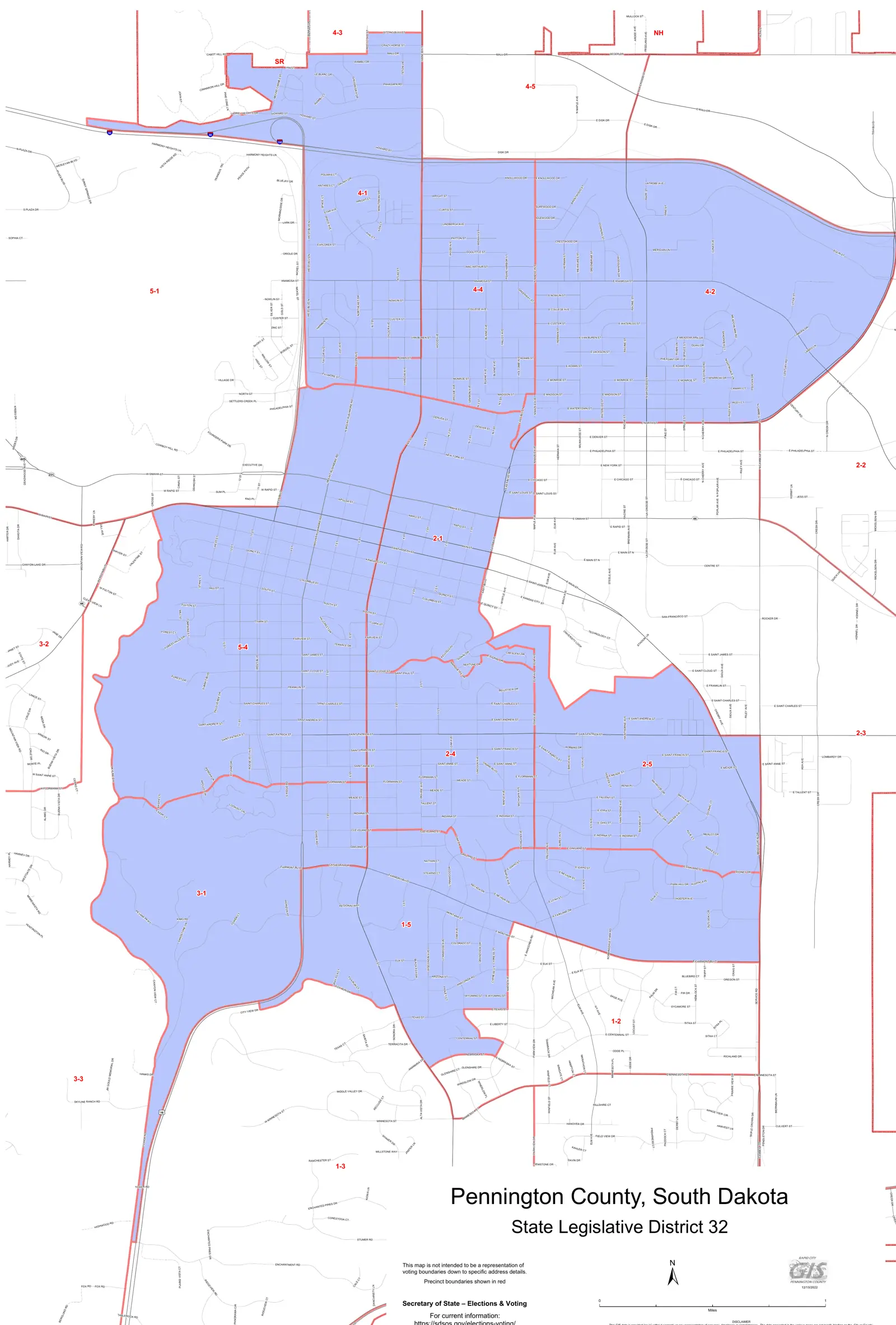
The line runs right through Rapid City. Here is the official map.

District 32 is downtown and North Rapid. If your home is in the shaded area, you get two votes for State House and I am asking for one of them.

South Dakota House District 32
Shaded area is the district. Red lines are precincts.
Map of South Dakota House District 32 in Pennington County: downtown Rapid City and North Rapid, shaded, with precinct boundaries in red

Source: Pennington County GIS for the South Dakota Secretary of State, Elections and Voting (December 2023). Not a representation of voting boundaries down to specific address details. Check your exact district by address at the state's Voter Information Portal.

Join the team

Vote Zac Martin

Door by door. Neighbor by neighbor. Yard sign by yard sign. This is a grassroots campaign for the heart of Rapid City, and that is exactly what it takes to win District 32.

(605) 600-3281·zac@zac4sd.com